

The app writes amounts the Polish way, with a decimal comma and a space between thousands, in the English interface too. On this page numbers are written the English way:
12 706,80 PLN on screen is 12,706.80 PLN here.Where do you see the price?
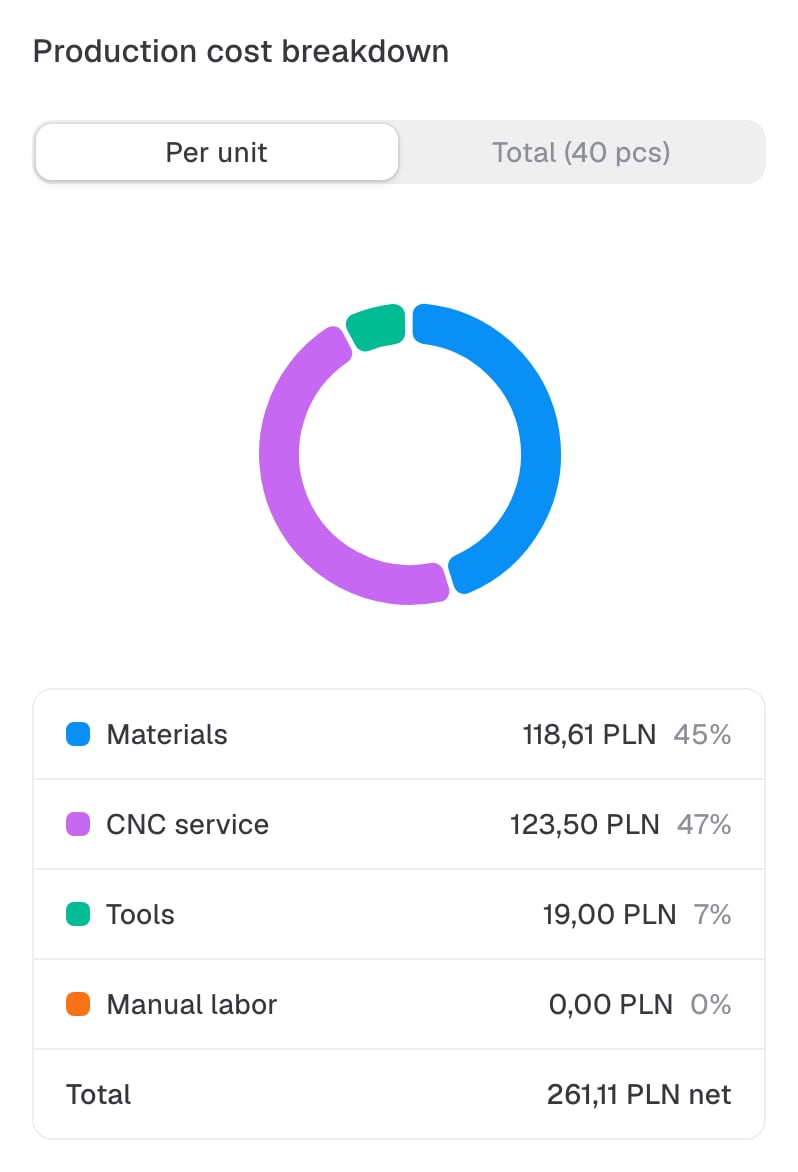
The panel has two parts:- Production cost breakdown shows what it costs you to make the part: materials, CNC service, tools and manual labor, each with its share in percent. The switch at the top flips between the price of one piece (Per unit) and the whole batch (Total).
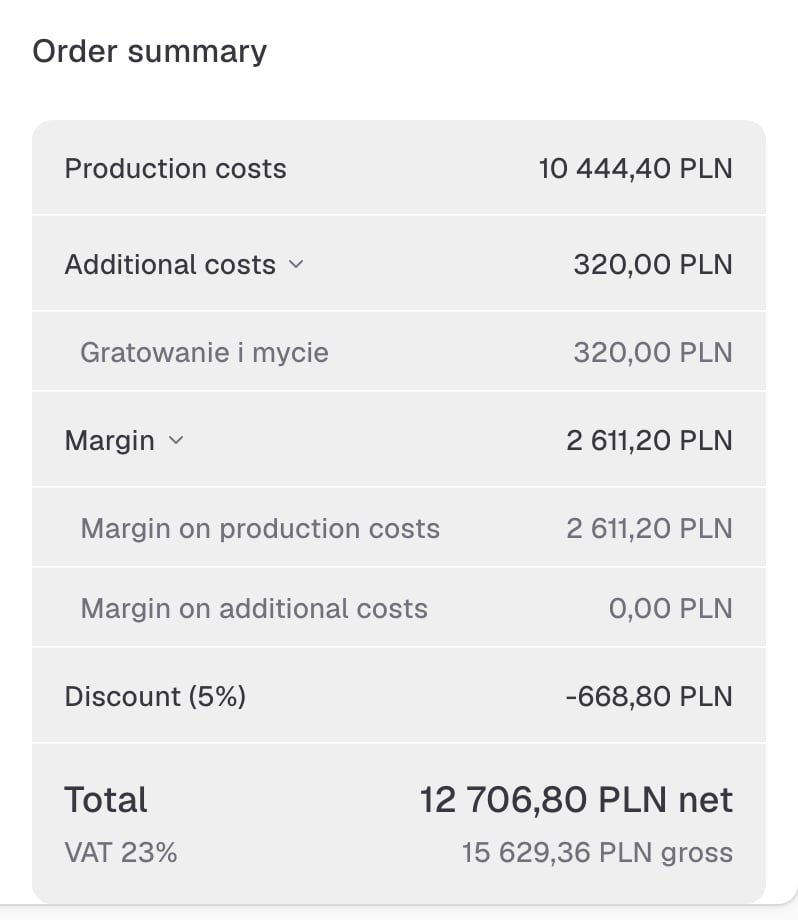
- Order summary adds additional costs, margin and discount to the production cost, and at the bottom shows the net Total, the VAT rate and the gross amount.
Example: manifold block H-200
Every number below comes from quoteWYC-2026-0006 “Blok rozdzielacza H-200” (a hydraulic manifold block) for Hydraulika Mazowiecka. Open it next to this page if you want to follow along.
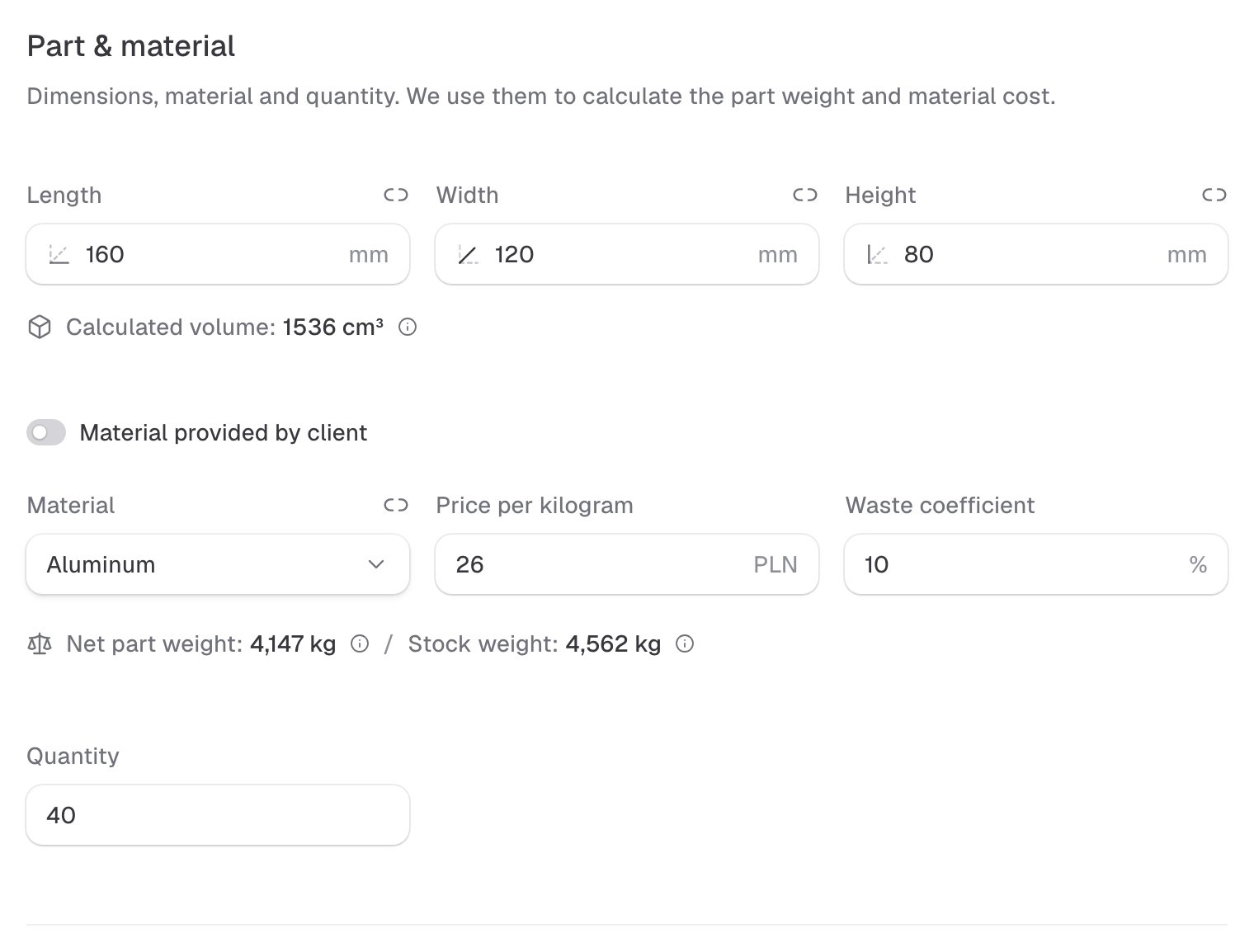
- Part & material
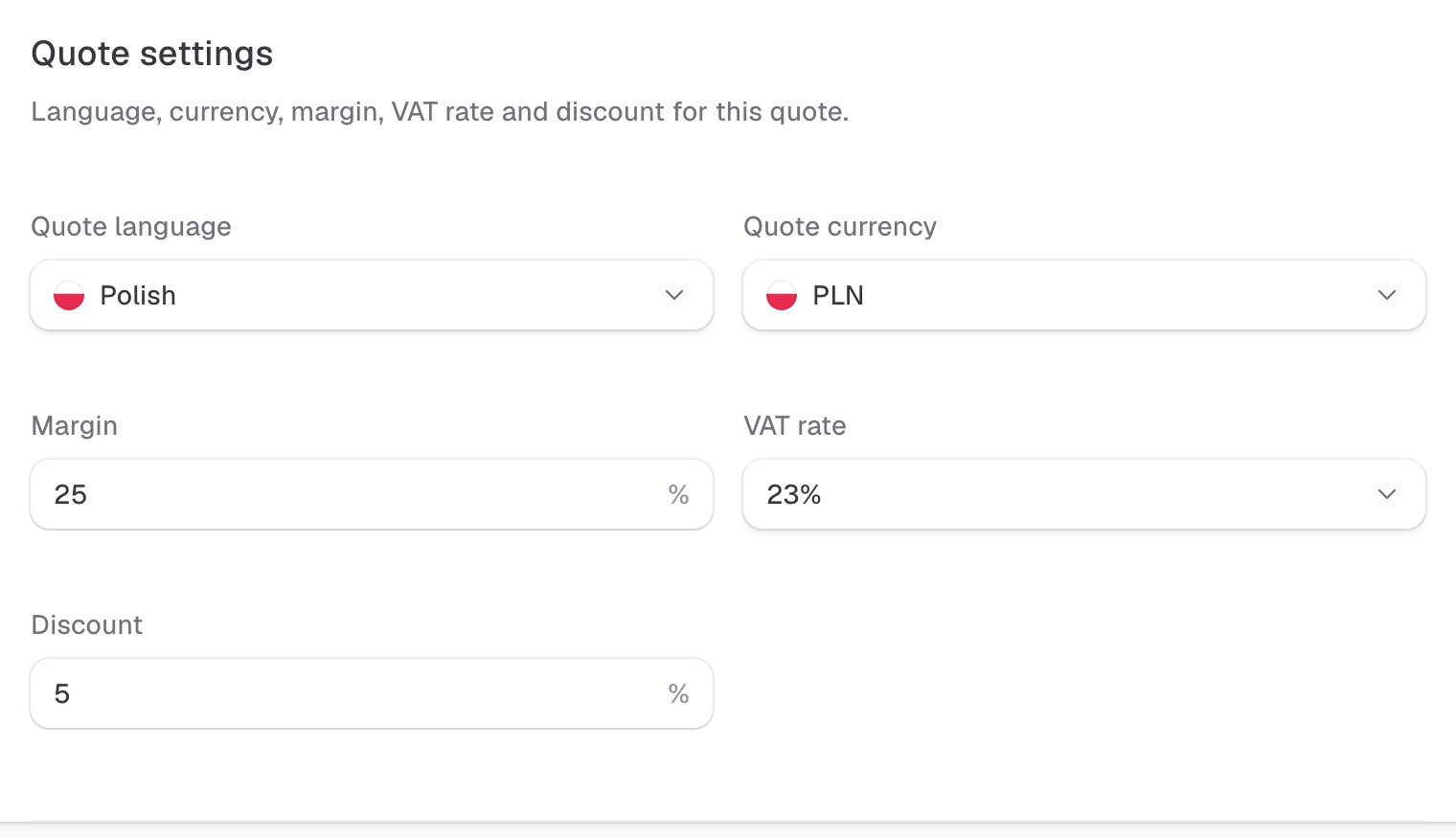
- Quote settings
Step 1: material
The app works out how much stock you buy for one piece and multiplies it by the price per kilogram.- Calculated volume = length × width × height ÷ 1000, so 160 × 120 × 80 ÷ 1000 = 1536 cm³.
- Net part weight = volume × material density ÷ 1000, so 1536 × 2.7 ÷ 1000 = 4.147 kg. That’s the part itself.
- Stock weight = net weight × (1 + waste ÷ 100), so 4.147 × 1.10 = 4.562 kg. That’s what you buy, including the allowance.
- Materials = stock weight × price per kilogram, so 4.562 × 26 = 118.61 PLN per piece.
Material densities the app uses
Material densities the app uses
Step 2: CNC service
The CNC service is machine time per piece: the cycle plus a share of the setup. The app converts minutes to hours before multiplying by the rate.- Cycle: 190 PLN/h × 38 min ÷ 60 = 120.33 PLN.
- Setup: 190 PLN/h × 40 min ÷ 60 = 126.67 PLN for the whole batch, so 126.67 ÷ 40 = 3.17 PLN per piece.
- CNC service = 120.33 + 3.17 = 123.50 PLN per piece.
Step 3: tools and manual labor
- Tools = tool cost allowance × cycle time ÷ 60, so 30 × 38 ÷ 60 = 19.00 PLN per piece. Setup time isn’t part of this.
- Manual labor is the amount from Manual labor / Locksmith, per piece, exactly as you enter it. In the example 0.00 PLN.
Step 4: production cost
The four items from steps 1–3 give the cost of making one piece, the Total row of the breakdown: 118.61 + 123.50 + 19.00 + 0.00 = 261.11 PLN per piece. Production costs in the summary is that piece cost times the quantity: 261.11 × 40 = 10,444.40 PLN. You’ll see the same amount after switching the breakdown to Total (40 pcs). The percentages next to the items are their share of the production cost, rounded to a whole percent.Step 5: additional costs
Each additional cost counts according to its unit:PLN/pcis multiplied by the quantity. “Gratowanie i mycie” at 8 PLN × 40 pieces = 320.00 PLN.PLN/totalis one amount for the whole order, whatever the quantity. Transport at 150 PLN is 150 PLN, not 150 PLN per piece.
Step 6: margin
Margin is what you earn. The app works it out separately for the production cost and for each additional cost:- margin on production costs: production costs × the quote’s margin, so 10,444.40 × 25% = 2,611.10 PLN before rounding,
- margin on additional costs: each cost × its own margin, so 320.00 × 0% = 0.00 PLN.
Step 7: piece price and discount
Next the app works out the price of one piece for the client: production cost with margin plus thePLN/pc additional costs with their margin. The result is rounded to the grosz:
261.11 × 1.25 + 8.00 = 334.39 PLN per piece before discount.
The discount takes a percentage off this price, that is off the price after margin. That result is rounded to the grosz too:
334.39 × 0.95 = 317.67 PLN per piece after discount.
The Discount row in the summary is the difference before and after the discount for the whole batch: (334.39 − 317.67) × 40 = 668.80 PLN. PLN/total costs get the same discount separately, each from its own amount with margin. The Discount row only appears when the discount is above zero. The panel ignores a value outside 0 to 100, and on saving the field shows “Enter a value from 0 to 100”.
Step 8: net, VAT and gross
The app works out the net amount the way an invoice does: the rounded piece price times the quantity, plus the per-order costs after discount.- Net Total: 317.67 × 40 = 12,706.80 PLN.
- VAT: 12,706.80 × 23% = 2,922.56 PLN, rounded to the grosz.
- Gross: 12,706.80 + 2,922.56 = 15,629.36 PLN.
The piece price is rounded to the grosz, and Total is that price times the quantity. So that the summary rows add up exactly to Total, the Margin row absorbs the rounding difference. In the example: 10,444.40 + 320.00 + 2,611.20 − 668.80 = 12,706.80 PLN. Total is the amount the client sees on the offer.
Amounts in the quote list
The columns you can switch on in the quote list use the same calculation:- Unit price (net) is the net amount divided by the quantity, rounded to the grosz. With per-order costs it may differ from the piece price on the offer.
- Margin is your profit after the discount: the net amount minus production costs minus additional costs.
What’s next?
Create a quote
What to enter in each field of the form.
Statuses and the PDF offer
How the client sees the price on the offer.
The quote list
Compare the amounts of many quotes in one table.